It seems unreal that it has been two years since Radu Jude’s endlessly satisfying Bad Luck Banging or Loony Porn (2021). Not simply because it is a film so dense in ideas, humor, and satirical precision that it’s hard to forget, but also because Jude has put out a handful of equally accomplished short films since then; he is a constant presence, for all the right reasons. For a filmmaker who works with such pace and infectious liveliness, it should come as no surprise that his latest feature film not only lives up to expectations, but somehow exceeds them in every conceivable way. With a title that implores us to temper our expectations for the final catastrophe, he does not prepare us adequately for what to expect in this consistently complex and rebellious film.
To place Radu Jude within a single tradition of film is an impossible and futile task. The Romanian filmmaker, who came to prominence through the Romanian New Wave, has been responsible for an eclectic body of work. In the early stages of his career he made the trenchant “family dramas” The Happiest Girl in the World (2009) and Everybody in Our Family (2011), and a few years later he went back in time to 19th-century Romania with Aferim! (2015), a film so close to the Western genre that you can practically taste the dust and grime on the shoes of the film’s drifters; and as soon as the next year he made the clinically precise Scarred Hearts (2016), set in a sanatorium in 1930s Romania. Since then, Jude has somehow managed to become even more difficult to pin down. From his archival documentaries The Dead Nation (2017) and The Exit of the Trains (2020), the latter of which particularly rigorous in its excavation of historic material, to the strange docu-fiction theater of Uppercase Print (2020), and of course the Brechtian masterpiece of “I Do Not Care If We Go Down in History as Barbarians” (2018).
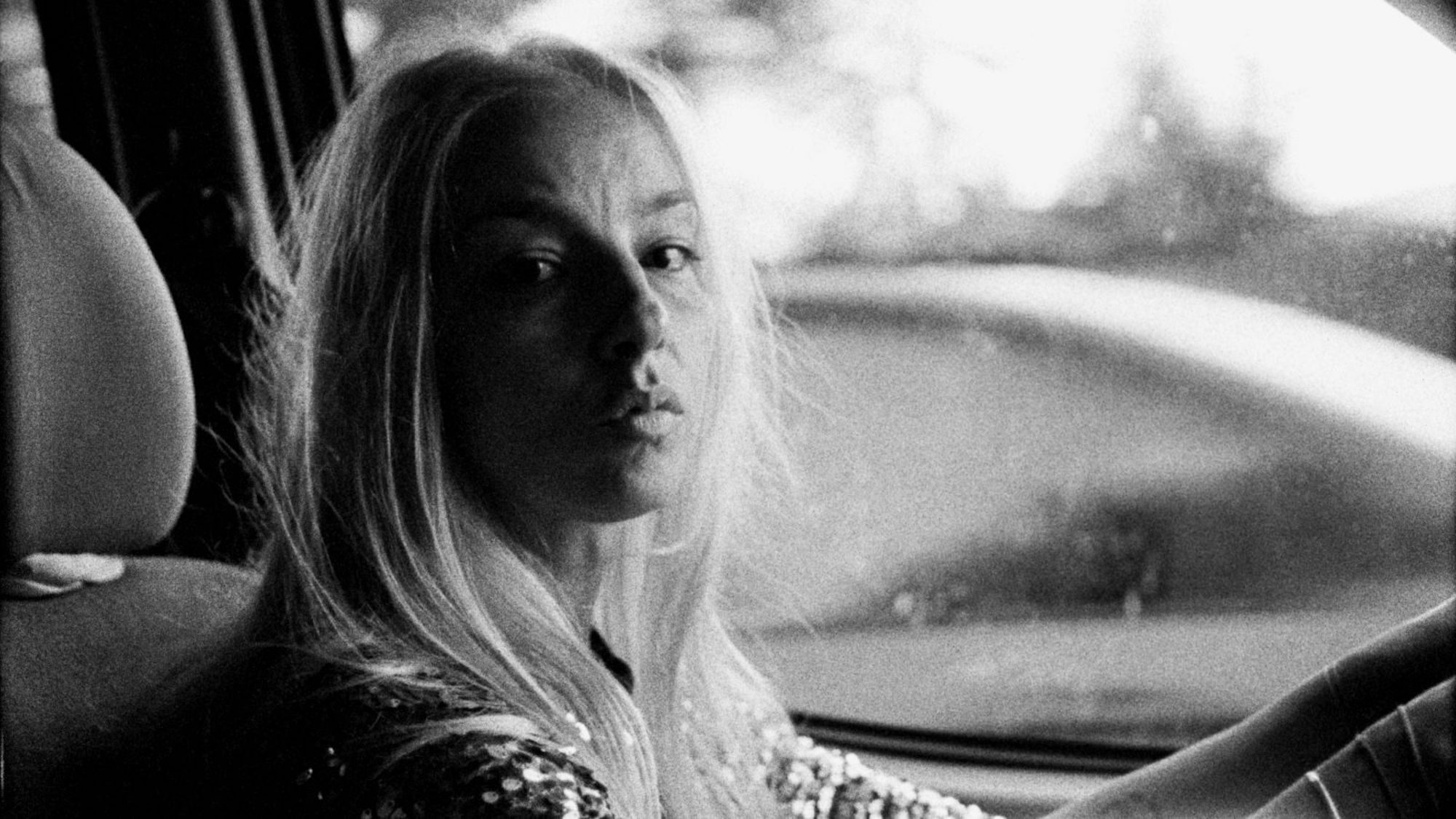
Do Not Expect Too Much from the End of the World sees Jude work in a similar register to his last three features, switching between genres and forms so effortlessly that its narrative cannot be confined to any one mode of formal expression. The film follows Angela (played by an exceptional Ilinca Manolache, known to Jude admirers in smaller roles in the past) as she drives around day and night shooting casting videos for a “safety at work” project commissioned by a major international corporation. She has no down-time, constantly on the road between subjects for the project—all of which have their own personal stories of work place injuries to recount—and when she asks her boss for a few hours off work to catch up on sleep, he tells her to “throw down a few coffees and Red Bulls and continue on the road.” In the few pit stops she allows herself, Angela spends her time as a content creator on TikTok, cosplaying an Andrew Tate-adjacent character via a video filter that makes her look bald, as she spews misogynistic and xenophobic hate speech to her audience. Jude implements these TikTok videos, all in their glorious form, in the film. These vertical interruptions feel all the more pronounced in their vibrant digital iPhone-color camera since Angela’s journey is captured on a heavily textured 16mm black and white film stock. Jude also intercuts the film with scenes from a lesser known Romanian film from 1982, with various titles but some places called Angela Keeps Going, which becomes a ghost both haunting and guiding the film.
Jude follows Angela on the road for two hours of the film’s 165 minute run time, where the last 40 minutes is a formally rigorous “one take” filmed from the perspective of the final commissioned video, where the selected worker and his family is placed center frame and asked to recount his experience. Throughout these 40 minutes people who represent the corporation prod and push at the worker from behind the camera to make him change his story. Not only asking him to leave out key details as “it might damage the business’ reputation,” but also deliberately altering the scene of the crime as more details emerge. A metal bar that was central in the incident becomes a hilarious and damning signifier, highlighting how well Jude understands the language of cinema. This entire section is at times most reminiscent of a silent film, and Jude pushes it to its absolute limits with bodies and automobiles and paper signs rushing in and out of frame at an intoxicating pace.
It is easy to see Do Not Expect… as the last film in an unofficial trilogy with Barbarians and Loony Porn, where contemporary Romania function as the stage in which Jude can trace not only the history of Romania, but specifically the history of images and images as a telling of history. While Jude has stated many places that he does not have a method as a filmmaker, among others in my interview with him for Loony Porn, there are two labels that certainly feel somewhat precise, one is “outrageously funny,” the other is the very loose idea of him as a “dialectical filmmaker.”
Jude’s dialectical notion of film and history is of course inspired by thinkers such as Walter Benjamin and the rest of the Frankfurt School (and others), as evident by the constant presence of Benjamin, Adorno, Kracauer etc. as citations in many of his recent films; the first segment in Loony Porn is even titled One-Way Street. This is no different in Do Not Expect…, and while Jude has always been interested in history as a continuous process in which past and present shape each other in both form and content in earlier films—the montage essay in Loony Porn‘s second part, and the diegetic layers of Barbarians for instance—never has he been so explicit in his examination of the history of image-making, and by extension, image-meaning. As mentioned above, when Manolache’s Angela drives around in contemporary Romania, Jude intersperses these sequences with scenes from Angela Keeps Going, which takes us back to the Ceaușescu-era in Romania. This is also where Jude’s examination of the historic image is most explicitly expressed throughout the film.
Through this intertextuality, Jude not only allows this “forgotten” film to be seen by more people, but also to cast these images in a new light. As our contemporary Angela travels many of the same roads as her cinematic precursor and/or specter, Jude slows down the footage in certain scenes to allow us (force us?) to see a Romania that no longer exist, but crucially also, a Romania that only existed in the peripheries of the original film. It would only be speculative hogwash to place intent on these images as they were captured and presented in the 80s, but by slowing them down in his film, Jude allows us to see these tangential moments, which in normal speed would pass us by too quick to notice, in a way that tells us a different story than before and one that bleeds into Do Not Expect…’s process of image-making. When our Angela finally meets a woman played by Dorina Lazar (the original Angela) these diegetic barriers are totally collapsed. Film history, to Jude, is then a mode of understanding both the past and the present, and the one cannot be extricated from the other. There is a dialectic of images in all of Jude’s work, that in this film become manifest in its narrative. While Jude may not have a method (I would maybe respectfully disagree), he certainly understands the weight and baggage of images as signifiers and meaning-carriers, both his own and those that have shaped his perception of the world and his art. Where a lesser filmmaker would settle for a simple re-contextualization of the original film, Jude allows it to re-contextualize his own as well.
One of the film’s strongest segments is when a casual conversation about highway accidents give way to a formal digression; a silent montage of roadside crosses, memorializing those who have lost their lives in traffic on this particular road. It is an interruption of the narrative and its fictitious frame, a sudden diaristic video essay with a formal rigorousness that stands in stark contrast to the unrefined and abrasive style of Angela’s time on the road, with its grainy black and white 16mm film, and the scenes from Angela Keeps Going. This intrusion works not only because of all it denotes about this real highway and these real crosses, but also for the way in which Jude here continues to examine the boundaries of fiction and reality in the process of image- and filmmaking. As with the incorporation of Angela Keeps Going, this segment sees Jude acknowledge his position as a filmmaker in a material world, in which the images he creates not only comes into fruition by his own labor and ideas, but as the consequence and effect of a long line of images throughout history. The reason this segment feels all the more powerful is precisely because it breaks its fictitious frame with a tragic reality, and a tragic reality that seems to loom over our sleep-deprived and overworked Angela on her time on the road within the films narrative.
When all is said and done, Do Not Expect… is maybe Jude’s most accomplished work to date for all the reasons mentioned above, but also because it’s as outrageously funny and precise as we’ve come to expect from him over the years. It’s a film that manages to feel extremely contemporary without ever giving in to any dominant formal forces of the day, which seems a rarer and rarer quality in filmmakers who attempt to look at the world around them. For this reason alone, Jude remain one of the best we have at the moment, and certainly one of the most engaging purely as a spectator.

