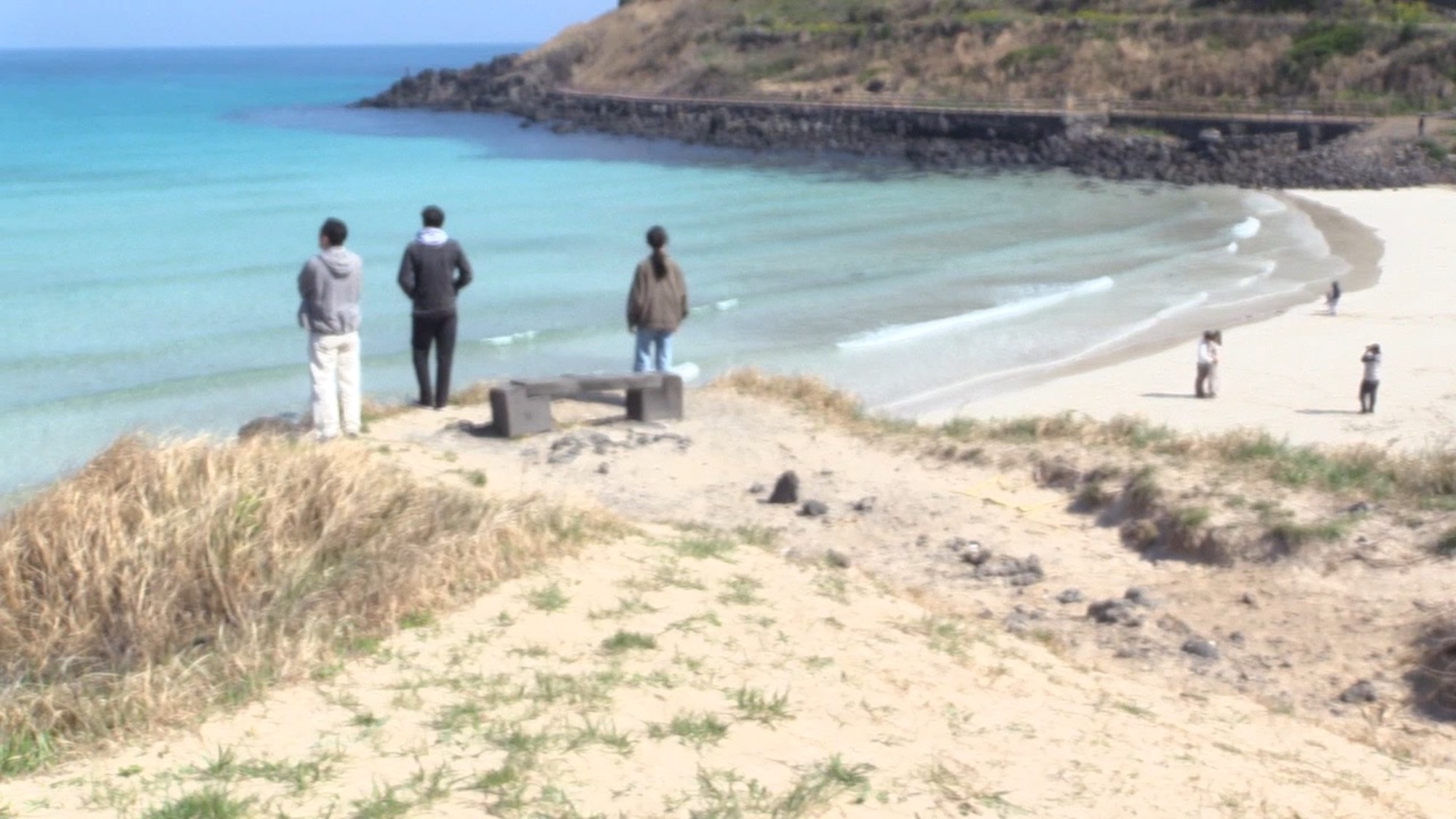
Water is wet and yet another film critic has proclaimed that Hong Sang-soo makes the same film every year. Platitudes like this follow Hong everywhere, almost as much from his admirers as from his detractors. This specific criticism is as aimless as it is dishonest, a shallow slight-of-hand where emptyheaded mockery stands as a substitute for actually engaging with the work. Repetition is no doubt integral to Hong’s project (as is alcohol and inconsequential men …), but as Dennis Lim puts it in his wonderful book Tale of Cinema: “for Hong, repetition provides a clear structure” and it is through this structure his oeuvre opens up to endless extrapolations. Earlier this year, at the Berlinale, he screened in water [sic]—he also closed the Director’s Fortnight at Cannes this year with In Our Day—and these objections have been abnormally absent from the discourse for various reasons, but perhaps the most obvious is that almost the entire film is shot out of focus.
in water is a Hong Sang-soo film through and through. As in most of his films, it follows a man, a woman, and another man. Sometimes the constellation varies; a woman, a man, and another man; or a woman, a man, and another woman… Here we meet Seoung-mo (played by Introduction’s (2021) excellent Shin Seok-ho), a young actor turned aspiring filmmaker who travels to the remote Jeju Island to shoot his first film with his friends, actor Nam-hee (Kim Seung-yun) and Sang-guk (Ha Seong-guk). Sang-guk, while a contemporary of Seoung-mo, is already a former filmmaker; disillusioned with the art from a purely financial perspective. The trio live in a small house paid for by the hopeful new filmmaker, and they spend their days talking, thinking, drinking, and sometimes filming scenes that Seoung-mo seems to discover instinctively as they wander the island.
In the context of Hong’s recent work, the allure of in water is particularly powerful. He is obsessed with the arts—its creation and its inspirations—and what it means for those who create it, those who encounter it, and sometimes those who are uninterested in it. His characters have been filmmakers and poets from the very start (“a novelist has an affair …” is the beginning of the synopsis for his directorial debut) and he has played with structural conceits for almost as long, but one can still identify certain periods or stages in his oeuvre (the delineation of which I’ll leave to people like Dennis Lim and Ryan Swen, both essential for those who want to understand Hong). I would agree with Swen that one could trace his current period from around 2018, with Grass (2018) or The Day After (2017), and while it is too soon to say with any certainty or legitimacy, there’s an argument to be made that he is in the process of another unfolding as a filmmaker. His obsession with the arts was fully united with his structural conceits in 2005 with Tale of Cinema, and while he’s always crafted beautiful looking films, there seems to be a newfound personal playfulness to be identified with The Novelist’s Film and now in water.
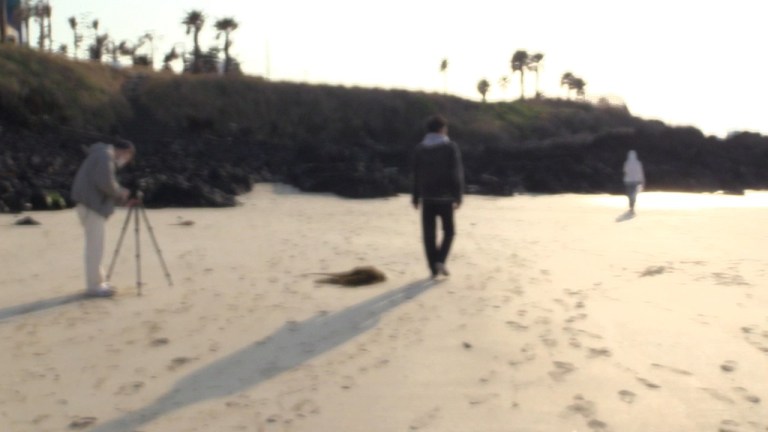
The Novelist’s Film (perhaps his most significant work for the ending’s brilliant culminating effect) is shot in over-exposed digital black-and-white, a mode of expression favored by the director in many of his films in recent years. This almost anti-aesthetic is scoffed at by some and embraced by others. As with the notion of unoriginality in his films, it is easy to reduce the “cheap” look of some of his films to a consequence of his productivity; as the inevitable result of his ridiculously fast turn-around and settle for the idea that “it simply doesn’t concern him.” I wholeheartedly disagree with this notion. While his films may be relatively cheap, they never lack intent, as evident by the ending of The Novelist’s Film (where the over-exposed desaturated image gives way to something truly transcendent), or the blur of in water. It is not only picturesque, at times most reminiscent of oil paintings, it also carries diegetic and non-diegetic weight. The amateur filmmaker in the film rushes ahead on instinct and impulse, the images he seems drawn to are not those who are perfect or clean, but those who speak to him in the moment. He doesn’t seem concerned with a predestined configuration of meaning, but rather with letting meanings fill the frame of his camera as he searches. Before moving on to the non-diegetic weight, it is worth pausing on the fact that the film barely has any other people in it than the young artists. With the exception of the older woman who rents them their house, there are no figures of authority in the film. Hong’s patented tired and frustrated artist never appears, nobody imposes themselves on the filmmakers to tell them about their naive attitude to the world and to art, and nobody attempts to tell them how to live their life or create their art. These figures often appear in Hong’s films, clinging on to relativity on the backs of new voices, but here the process of experimentation and unconventionality is left alone to flourish on its own. To find its own way through the blur.
While meta readings of Hong’s films are often more reductive than instructive, losing sight of repetition as a structural device in favor of simple biographical readings, it is difficult to watch in water without thinking of his weakening eye sight in real life. It’s not the first time this leaks through the diegetic barrier of his films, but the blur of in water is so persistent, personal, and painterly that it becomes almost impossible to not read it as a more direct confrontation of said diegetic barrier than in his earlier periods of work. The film ends on a note that seems to gently invite us to reconsider the gaze of the camera, before a devastating pan to the ocean, that closes the film. The Novelist’s Film ends on a thematic and aesthetic note that is inherently personal, and remains my favorite moment in Hong’s oeuvre, and with the blur of in water it seems that he is perhaps letting us know something more about himself yet again.

