In Pedagogy of the Oppressed, Brazilian educational philosopher, Paulo Freire writes concisely about his theoretical notion of “naming the world” and the profundity of said notions radical praxis. It’s a work of great philosophical density and political precision, and a seminal text in the canon of post-colonial literature. Freire has not been as influential for cinema as many other philosophers, but he can be discerned in the works of filmmakers such as Ana Vaz and Sarah Maldoror—the former’s Apiyemiyekî? explicitly interrogates Freire’s ideas as they pertain to the intergenerational consequences of the 1970s genocide of the Waimiri-Atroari Peoples. Sadly, it’s difficult to recall many—if any—major releases that can be traced back to naming the world in the Freirerian sense.
It is slightly surprising then, that this year’s edition of the Bergen International Film Festival saw two films that, in their own ways, seem to engage with these ideas. Neptune Frost, by directors Saul Williams and Anisia Uzeyman, is most explicit in its anti-colonial, anti-capitalist, pro-worker messages; whereas Apichatpong Weerasethakul’s Memoria confronts similar ideas in the subtext of its rejection of the western aesthetic and the way in which Weerasethakul deliberately disrupts his traditional slow cinema to jolt the audience awake. There’s a lot to be said about both films, but in this text, I’ll limit my analysis to Neptune Frost to give it the attention it deserves (Memoria, and its brilliant final act, will be for another day).
Williams and Uzeyman’s film has been eloquently described as an Afro-Futurist musical featuring an intersex hacker, a coltan miner, and a beautiful ensemble of various voices that form a union in Rwanda. The film begins with the death of a worker. A coltan miner named Techno discovers an ore that emanates with a peculiar force, and as he is transfixed by its essence, he is hit in the head by the armed soldiers of The Authority (the controlling forces of the film’s world). His close friend Matalusa (Bertrand Ninteretse) is lost to despair, but as he painstakingly carries the body of his friend through the field, the film breaks immersion for the first time, when the sound design is interrupted by a powerful composition of diegetic drums. The rhythm and volume build as the camera pans around slowly to reveal all the workers in harmony, with their own drums, singing loudly and proudly in honor of their fallen friend. The workers may not own their own labor, but through this ritual, they manage to reclaim autonomy over their own personhood and fellowship. The title card clashes onto the frame, announcing itself with fervor and confidence.
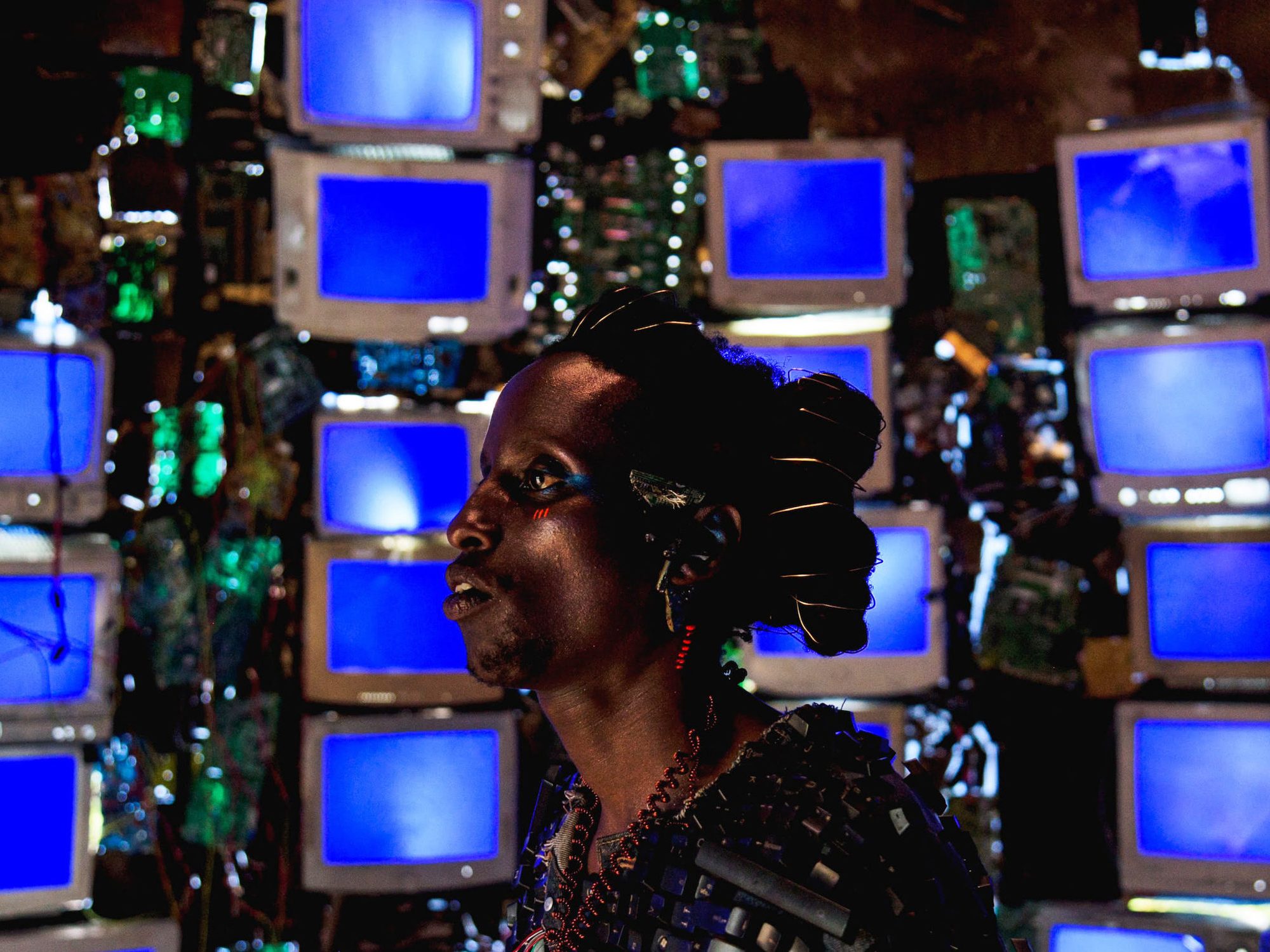
The film never loses its audacious tone. As we follow Matalusa, and soon the intersex hacker Neptune (played by Cheryl Isheja and Elivs Ngabo), the story moves with slow determination to the point in which the two meet in an enigmatic space that seems to be a safe haven for various people that have been rejected or are hunted by The Authority. In this place, the bond that is formed between Matalusa and Neptune—and the others, such as Psychology (Trésor Niyongabo) and Memory (Eliane Umuhire)—becomes a tangible expression of political activism, through both theory and praxis. The ensemble of poets, artists, hackers, etc. break into many different musical numbers (with an impressive variety of genres and styles), and as they sing truth to power, the world around them is directly affected by their words. Neptune becomes infamous, the film intermittently disrupted by news broadcasts (mimicking the looks of CNN and similar channels) and the digital static of lines of code that seem to be a concrete call to arms. Neptune, through shared experiences expressed through song, manages to hack into the systems of the world and create absolute devastation for the rulers. These interruptions pull the audience away from the world of the film and surround us in code and colors that take on different shapes that seem to aspire to become its own entity, or at the very least reject the digital imperialism of the modern surveillance state(s). They are brilliantly conceived of and executed, and fill the frame with a sense of visceral depth that is truly rare in digital effects.
One of the best scenes of Neptune Frost occurs near the midpoint of the film when Neptune arrives at the location that Matalusa and the others have made camp. As Neptune breaks through the invisible barrier that surrounds the encampment, it is like the entire world vibrates with the intensity of their presence: there is an uncertainty to the camera, as Neptune finds their footing, now clothed in a beautiful dress of metallic gold. Then, as Neptune moves toward the others, the camera is steadily fixed on their face and upper body as they seamlessly glide through the terrain together in an impressive dolly track. Neon hues illuminate Neptune’s face and the gold of the dress, while we hear the rhythms of Matalusa and the others become louder and louder. Neptune, with us, edge closer and closer to the encampment and what will be a revolutionary camaraderie of class solidarity and political activism. “Picture your dream and dare to live in it” is a mantra in the film, and in a sense, it feels like this is what dictates the emotional and political core of the narrative. It is a simple yet profoundly meaningful idiom, which is at once inherently personal and communal. The industrious community at the center of Neptune Frost comes together to picture a shared dream, one in which The Authority (and all their likes) is demolished, and through solidarity, they dare to live in it.
In the Q&A at TIFF2021, director Williams spoke about “the irony that exists between modern technology based on analog exploitation.” He is speaking about the opening scene with the analog labor of the coltan miners, and the fact that these resources are used in modern technology that in turn function to further exploitation and oppression. He also speaks about the creative process for Neptune Frost on different occasions, and he has made clear the fact that it was originally conceived of as a graphic novel and a stage musical. This seems to have inspired Williams and Uzeyman to play with the language of cinema, and it elevates it to new heights that might not have been reached without a deep knowledge and passion for these different mediums. Williams has also spoken about the way in which the music was written in collaboration with the different actors and artists that appear in the film. Lines such as “first they cut the radio / then they cut the television / then they locked down the internet” are taken from the actors’ experiences in Burundi, before they left for Rwanda. This collaborative, non-hierarchical approach to filmmaking isn’t revolutionary in itself, but the way in which directors Williams and Uzeyman have allowed their on-screen talent to speak truth to their reality, to name the world that they’ve experienced first hand, is quite powerful.
The relevance of Freire’s notion of naming the world—and the reason Neptune Frost‘s willingness to do so—is so important still can be seen in countless situations and horrors of today. From Israel’s brutal ethnic cleansing of Palestinians to China’s horrific genocide against the Uyghurs Muslim population. These atrocities, and many others, are talked about in a manner that either a) complicates the situation of oppressor/oppressed beyond recognition through obfuscated language, as to maintain the status quo, or b) ignores it completely. This is particularly true of the language used in the Israel/Palestine conflict, in which people resort to the pseudo-diplomatic language of “Israel has the right to defend themselves” (as if state warfare, supported by multimillion-dollar donations from the USA every year, is comparable to homemade rockets that are mostly intercepted by the Iron Dome) or “the conflict is too complicated to judge” (ahistorical at best, deliberately ignorant at worst). This obfuscation is of course rooted in American imperialism—which in turn is rooted in colonialism. Saul Williams and Anisia Uzeyman’s film is the anthesis to this obfuscation of language: they boldly and declaratively confront the injustices of a post-colonial world and the intersectional struggles that come out of it.
In the end, Neptune Frost is an Afro-Futuristic musical that boldly names the world through ingenious and beautiful songs. The film opens and closes with a bombastic heartbeat, as the coltan miners take to their drums to reclaim their autonomy with a sense of mournful optimism for the future. It is a brilliant testament to the importance of intersectionality in class solidarity: the film deals with queer identity, the fluidity of gender and sexuality; it deals with the struggle for autonomy in a capitalist society or the relation of free labor and slavery; it deals with the inherent neo-colonial theft industry that is private property, and it deals with so much more. Williams and Uzeyman have created a film that is bombastic, bold, and brave, and one that is entirely sure of itself in both form and content. It’s a film that moves and inspires, and through its radical praxis of naming the world, it might actually make a change.

