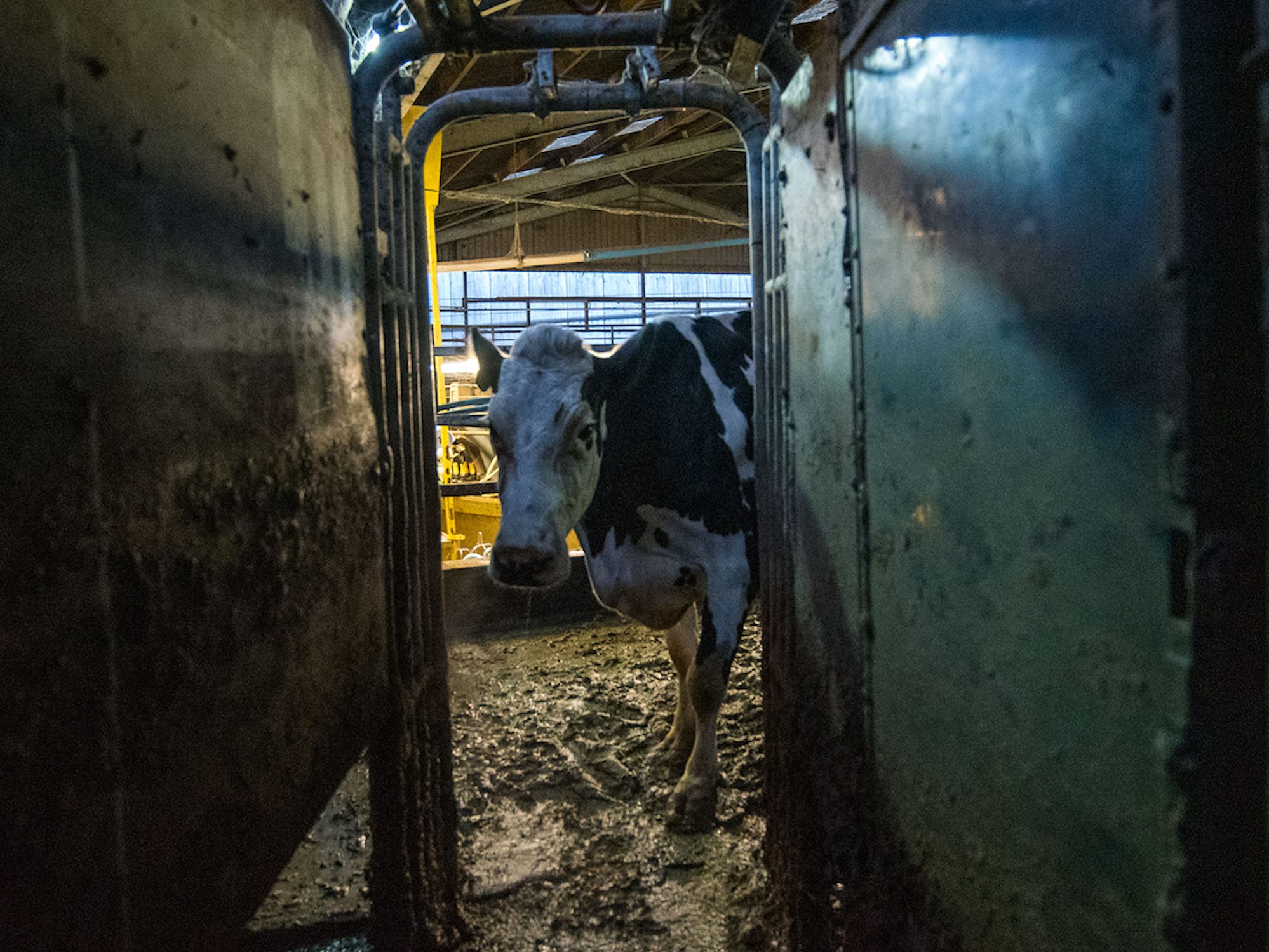
On the surface, Andrea Arnold’s first documentary may seem like a radical formal departure from her fiction work, and in some ways, this superfluous observation rings true, but it also shares many of her earlier preoccupations. Cow is bold in its commitment to bleak immersion, and the film is simultaneously uncomfortable in its insistent perspective and warm in its dedication to its subject’s experiences. Arnold, and her team, keep the cameras pointedly fixed in the dirt, mud, soil, and fluids of the cows’ confined spaces, which makes cleanliness and comfort a sensory impossibility.
The visceral nature of Cow might be a struggle for a lot of viewers—myself included—as it confronts you with so much dirt, soil, and bodily discharge that you can almost smell it in the theater. Arnold announces this formal sensibility in the very first scene when we are treated to an extreme close-up of the birth of a calf, feet first from her mother’s womb, the camera almost clinically detached from the mother as it focuses on the primal nature of new life entering the world through blood and excretion. It is confrontational, but it’s also honest, and Arnold returns to the scene in an aesthetic contrasting towards the end of the documentary, with yet another birth. This time the camera is fixed on the mother’s face, while the emergence of new life is out of focus; the farmers’ apathy is made stronger as they are relegated to shapes and colors in the background, simply doing their work. Cinematographer Robbie Ryan, who has collaborated with Andrea Arnold on all her feature fiction films, has been replaced with Magda Kowalczyk, which only works in the film’s favor. While Ryan is certainly a talented cinematographer, capable of fulfilling Arnold’s vision, he does have a predilection for the beautiful. It’s not that Cow is never beautiful to look at—some of the exterior sequences are striking—but Kowalczyk seems more willing to plunge the handheld camera into strange, uncomfortable places and contortions that are neither pretty nor cathartic.
Cow will inevitably draw comparisons Gunda, the latest documentary from director Viktor Kosakovskiy since the superfluous similarities—immersed observation in place of narration and lecture—are quite obvious. I have not seen Kosakovskiy’s film, because I find him a tasteless filmmaker with amoral journalistic principles, but I suspect this comparison is unfair to Arnold’s film for two reasons: 1) Arnold is a sympathetic and emotional filmmaker, who has clear tendencies towards understanding and love and 2) Arnold’s film is, I suspect, more in the tradition of Lucien Castaing-Taylor and Véréna Paravel, particularly their sensory marine nightmare, Leviathan. Castaing-Taylor and Paravel have been criticized by some for being too detached and observational, particularly for the controversial Caniba, but the brutalist sensibilities in their films—which take on an inhuman perspective to convey the nightmarish work conditions under capitalism in Leviathan—is in a sense carried on by Arnold in Cow to fully immerse the audience in the bleak and brutal conditions in which they endure.
In the end, any comparisons to similar documentaries are quite reductive, as it is still an Andrea Arnold film. Her preoccupations with womanhood and displacement are still present, and in a sense, you can argue that it’s her most direct film about the idea of motherhood and displacement yet. This is acutely demonstrated in the birthing scenes that we see contrasted in the film’s opening sequence and close to the credits. It is difficult not to anthropomorphize the subject in documentaries about animals, both for the filmmaker and the audience. This is especially so in documentaries that deal with traditionally domesticated animals, such as Ceyda Torun’s Turkish street cats in Kedi and Elizabeth Lo’s vagabond dogs in Stray. What this instinct to anthropomorphize says about us—and our willingness to force the vulgar machinery of large film cameras in their faces—is a debate for another day, but in the case of Andrea Arnold’s Cow it is difficult to tell whether it is Arnold or me—the audience–that is the main culprit in the process. Arnold’s contrasted births seem to suggest that she may be struggling with this question herself. It’s a question that goes in line with the questions of morality in animal filmmaking, yet very few films seem to actively engage with this problem. Cow may be part of the problem—if you see these documentaries as amoral—but it seems interested in suggesting a solution.

