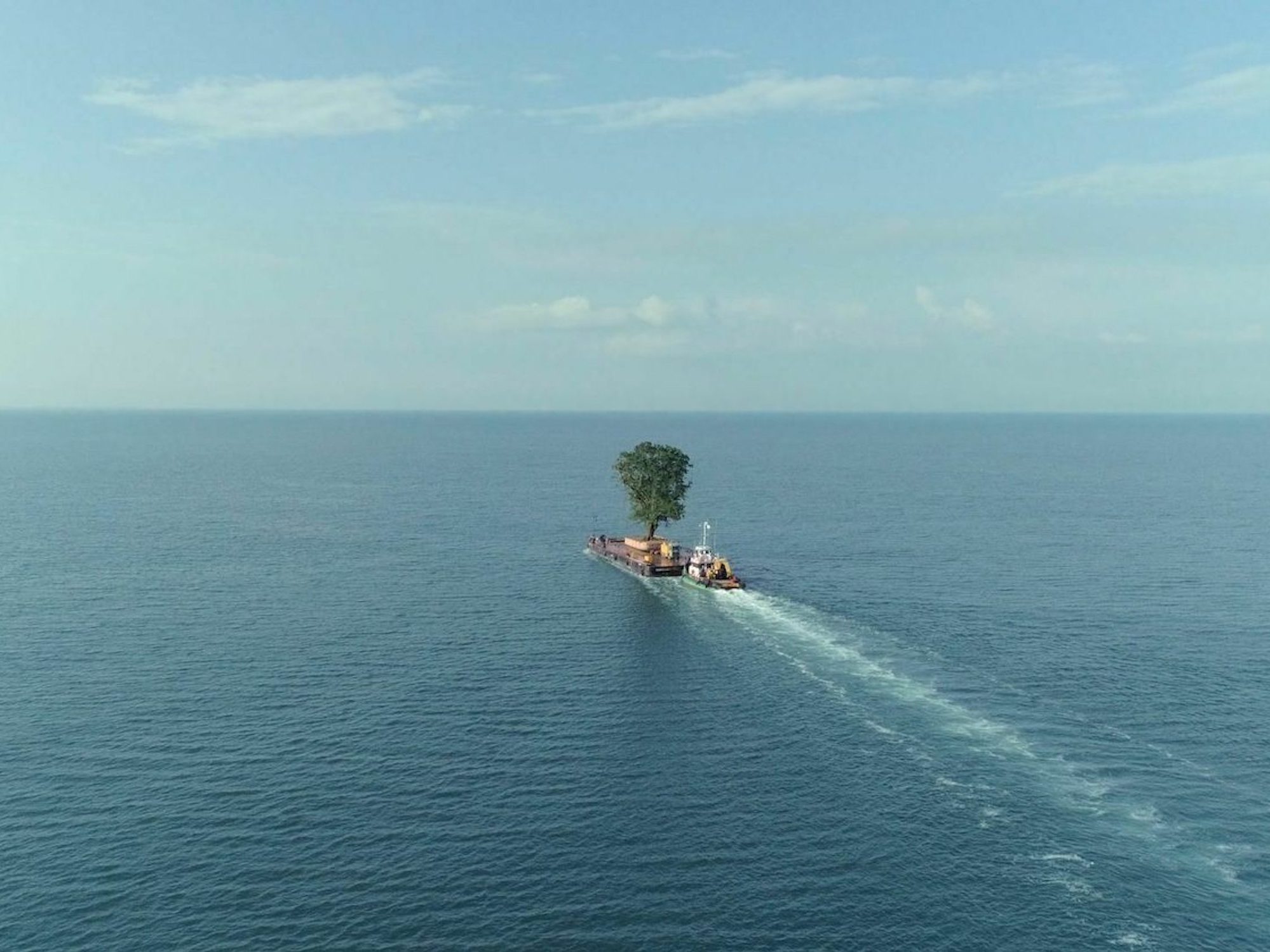
Motionless, distant, and indifferent. The camera’s presence in Salomé Jashi’s brilliant Taming the Garden is persistent in its disaffection. It exists not to infringe upon the world, but rather for the world to infringe upon it. This is a patient documentary about a tree, cut down and torn from its extended roots. The passivity of the task, in stark contrast to the startling ahistoricity of uprooting natural monuments.
In Taming the Garden there’s an omnipresent man, one who we never see or hear, but who is a constant figure in each scene. He is one of the richest men in Georgia, and he owns a garden. The man wants to grow and expand it, to create a monument of and for himself. To do this, he sends his commissaries across the country to purchase large and impressive trees, to have them shipped back to his garden.
He constructs his own personal Eden, a metaphor which allows him to see himself as God, but unlike the Original Garden, this is solely for himself. A flourishing and breathing monument that will outlive all of us, the man included, and their vastness will cast large shadows across Georgia for many many years, but they are shadows of what is lost, not what is alive.
Jashi’s film reflects the monumental identities of the trees through her cinematic language. Constructed of long and still shots, the camera rarely moves but simply exists in the presence of the great greens. The film is also quiet, almost entirely without non-diegetic sounds, as to allow the wind in the leaves and the creaking of wood torn from its roots and dragged across concrete and ocean to be heard. We see people work at the trees, digging them up and tearing down the surrounding forest to make room for the transport. They talk of anything and nothing. They talk of the people who agree to sell their land to this man because they are in need of money or food. We see a small crowd follow one particularly large and impressive tree be carried across their town, never to be seen again. Should these people, who have seen family be born and die while the tree remained, ever travel to the man’s garden, they would have to pay to see it again. As they follow it out of town, we see some cry, others laugh, and some feel nothing at all. The only constant in their reaction is that something that was once theirs, together, is now owned by a single man. A stranger.
The distinction between private property and personal property is one that isn’t talked about enough. It’s been written extensively about in political and philosophical theory, but it’s rarely commented upon in popular culture or the media. In Norway, we simply do not have the proper language to address the distinction, which in turn makes it easily perpetuated ad infinitum by those who own the land and the means of production. Taming the Garden makes this distinction painfully clear, and while director Jashi never resort to cheap moralism, it reveals the inherent amoral exploitation of private property as exactly that; exploitation of the poor and working class, across borders and seas. The rich get richer, and as they build their fortune and their gardens on the backs of other people’s labour and wealth, we slowly but decisively lose our own place in the world.

