The Galician filmmaker Lois Patiño made his feature film debut at the Locarno Film Festival in 2013 with Coast of Death, a documentary that observes a landscape made up of brutal dichotomies: stunning ocean views and waves crashing in over jagged rock formations; beautiful mountain peaks and steep plummets; people working the land and the sea, while nature pushes back at them. The region has been baptized in the same ocean we observe, an ocean that has taken countless lives during storms and furors of the sea. We see bodies occupied by labor, work, and leisure as tiny silhouettes in the immensity of the landscape, Patiño bringing us closer to them only through voices—bridging vast and unforgiving distances.
Seven years later, Patiño returned with a feature film at the Berlinale in 2020 with Red Moon Tide; once again returning to his native Galicia, and the myths, folklore, and legends that come from the area. Bodies are again scattered across the Galician landscape, frozen in place, trapped by both the film’s temporality and spatiality. They are specters of inhabitants of the land, musing on their shared cultural and mythical legacies, as they mourn a ship-wrecked man.
It wasn’t until three years later, again at the Berlinale, that Patiño would have his major breakthrough with Samsara. A film Patiño wants you to watch with your eyes closed; or at least 15 minutes of it. These 15 minutes are some of the most evocative and transcendental moments one can have in the darkened room of a cinema this side of the new decade, not only being a daring conceptual achievement in terms of cinema’s formal possibilities, but also a moving and hopeful flourish of narrative ingenuity.
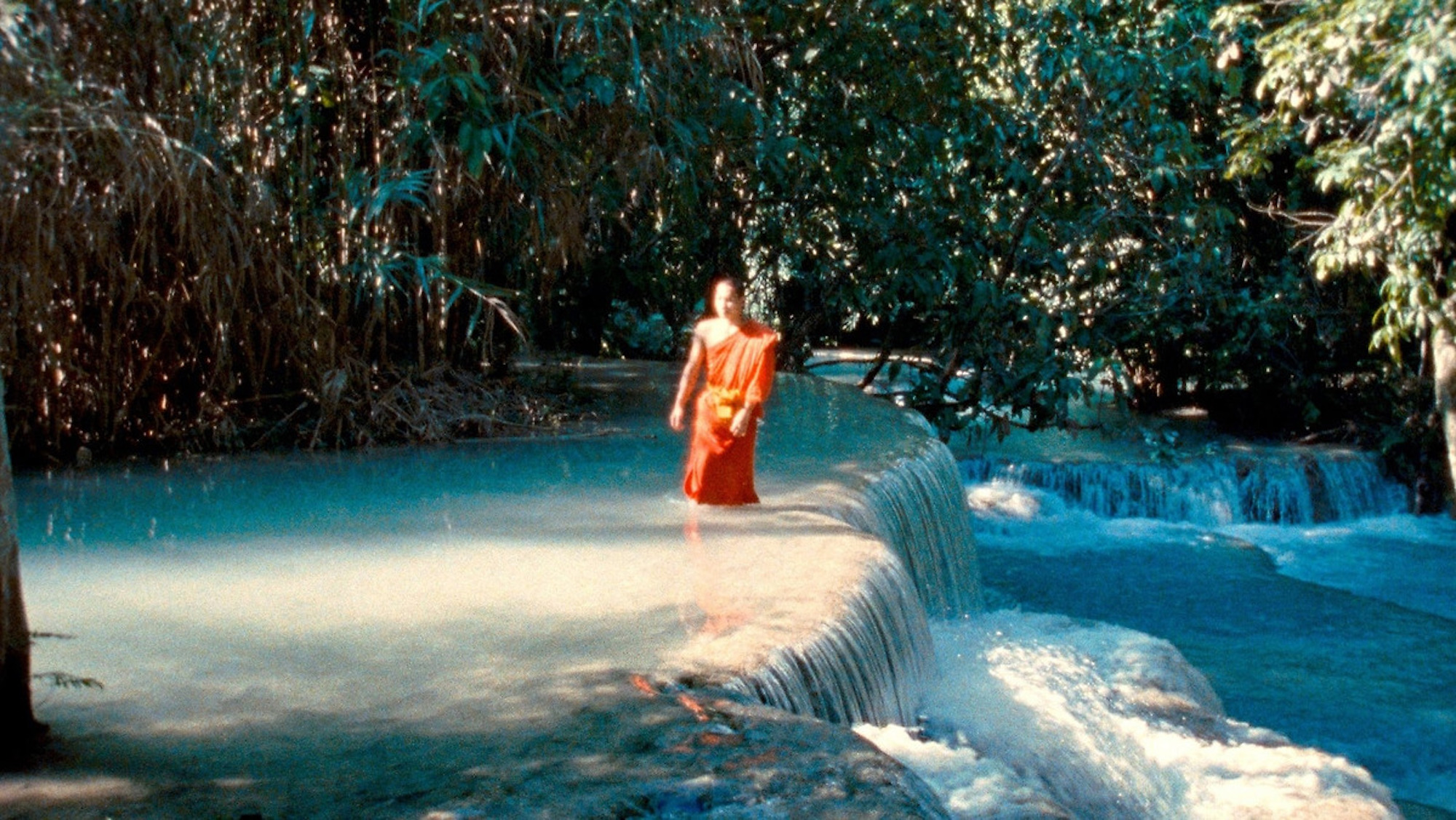
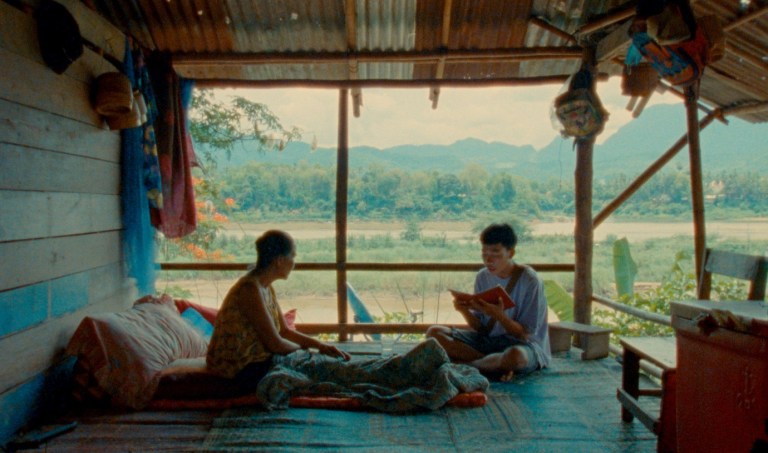
In the first 40 minutes we get acquainted with a small community of young monks at a Buddhist school in Laos. One of the boys we meet is not a monk, however, but a local who takes care of domestic duties for his family, but also lends a helpful hand to those around him; from ferrying the monks from their school to a serene and almost dream like waterfall where they swim, sleep, and saunter; to reading the Tibetan Book of the Dead to an old lady who will soon pass on from this life.
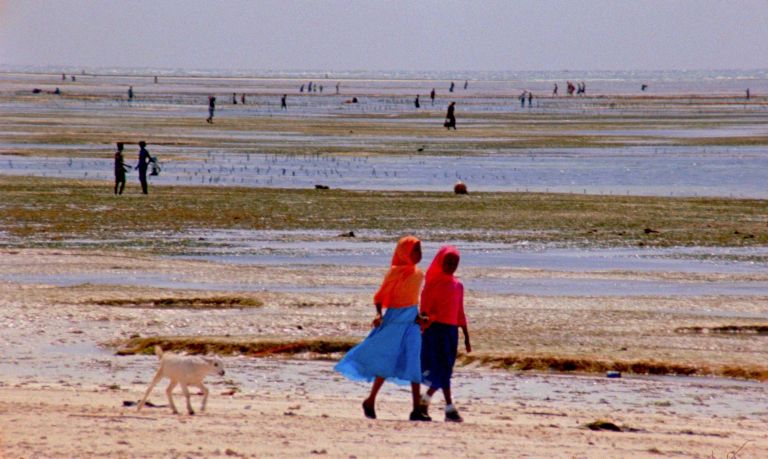
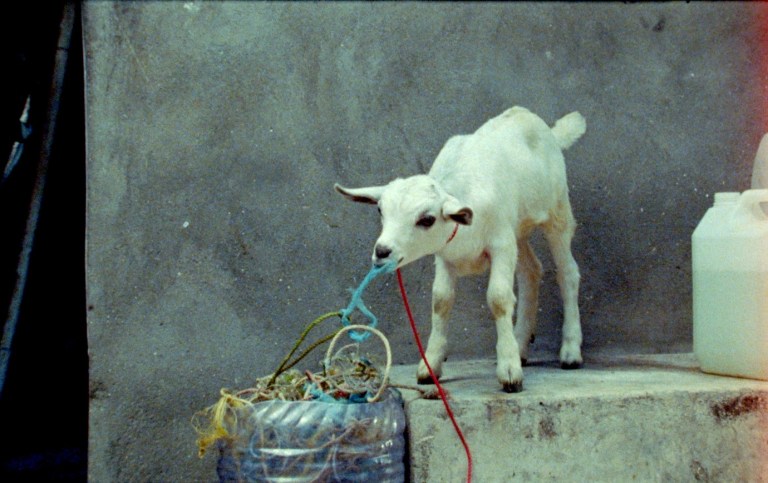
When she eventually does so, the films explicitly tells the audience to close their eyes, to join her on the journey through the Bardo—the space between death and rebirth. For 15 minutes the film exist on the other side of your closed eyelids, where you are guided alongside the old lady by bright colors that dance and flicker, and sounds of both eerie uncertainty and welcoming familiarity. When the sounds and lights go out, when their reverberations through your closed eyes and open ears let up, we are reawakened in Zanzibar. Here we follow a young girl and her newborn goat, where a small community of women work the sea weed farms on the beaches, the children (and the goat) go to classes, and the men work the fish markets.
I sat down to talk with Patiño about this remarkable work to figure out where the idea to make a film to watch with your eyes closed came from, what light and sound means when the spectator won’t see the screen, and the communal experience of being in a cinema where everyone is welcomed to conjure up their own images. We talk about this, and much more in this interview, and touch on references as varied as Derek Jarman and Teddy Williams, to Mircea Eliade, Sigmund Freud, and Henri Bergson, as well as how Patiño feels about comparisons to Apichatpong Weerasethakul and the notion of people falling asleep during his films.
NOPRESS (NP): It has been a year since Samsara had its world premiere at the Berlinale in 2023. How has this year been for the film and for you?
Lois Patiño (LP): It has been really amazing since the very first screening. Even before, because it was selected by Carlo Chatrian and [Mark] Peranson and the whole Berlinale crew very fast. They watched it and called us and told us they had selected it. Already after the first screening we had really amazing feedback, with many people telling us they won’t forget the experience.
I’ve been really happy with the idea of the film since it came to me, this idea to make a film to watch with your eyes closed. I had the idea five years before, and I knew it was a strong one, but I needed to find what it will mean in terms of narrative in the film. I knew what it would mean conceptually, but not for the narrative. So, when I found the Bardo Tödröl (commonly known as The Tibetan Book of the Dead), I knew we had something that’s strong. I am also very interested in the spectral, the phantasmagorical; the ways different cultures reflect about the afterlife.
The film was traveling a lot to different film festivals this past year. Right after Berlin we couldn’t show the film until April at the Jeonju Film Festival in South Korea; since they are co-producers of the film they wanted to have the second screening. It was some months where the film couldn’t travel, but after that it traveled a lot. This was something new for me, this and that it had a lot of international releases in commercial theaters. Four days ago (as of 30.01.2024) the film came to theaters in the UK and Ireland, with the very strong distribution company Curzon. In Madrid it has been in theaters for one and a half months, and it already has over 10,000 spectators. For a film of this nature, it’s very good. It’s been to Brazil and Lithuania, and it’s going to the Netherlands, Belgium, Luxembourg. It’s been a really fantastic year; we are very happy.
NP: I am very glad to hear that. You briefly mentioned that it’s an idea you’ve been thinking about for some years, but how did you come across the book and decide on that?
LP: I’ve always been very interested in anthropology and comparative anthropological approaches, like the Romanian writer Mircea Eliade. He did some really deep studies about myths, legends, and religions. About different themes, but very spiritual in general. For me, he was very inspiring since I was a teenager. My previous feature film, Red Moon Tide, was about how we relate with death and how we imagine the afterlife and the imaginary beings of our culture in Galicia where I come from, which is different from the Spanish one. It’s a region in the northwest, and the most important imaginary beings from our culture is the procession of phantoms called Santa Compaña and a sort of witch called meigas.
I think, both in terms of the theme, this way of understanding the afterlife, and also the idea of the invisible came from following these phantoms. The idea of making a film to watch with your eyes closed came because I was exploring the idea of phantoms, and the invisibility of the phantoms. From there, I got to this idea of how cinema can reflect about the invisible, but it was always coming from the idea of the spectral aspect of the phantom.
I knew about the Egyptian book of the dead, and I don’t know how or when I found out about the Bardo Tödröl, but I bought it and read it quickly, and suddenly everything [fell into place]. It was like a perfect match in my head. From there the structure of the film appeared; the two bodies, the two cultures, the two different landscapes. I like this idea of a comparative anthropological approach. I also had in my mind the Teddy Williams film, The Human Surge; not the third, but the first one. I admire him a lot, and he’s a friend of mine. I like how in his films he is focusing more on the youth: their difficulties in finding a job and the [challenges] they have in the world in general. I like this idea of a kind-of comparative anthropology a lot. That is from where it appeared.
NP: It’s funny you mention Teddy Williams because I actually spoke to him a week ago about The Human Surge 3, and I have been thinking there are some similarities in how you cross boundaries and how you go from one place to the next. I wanted to ask about this, but maybe we can start with the middle section, the Bardo sequence I guess we can call it. You said you had this idea for a long time, but how did you arrive at the end result, the colors, and the sound?
LP: I always had the idea to watch it with your eyes closed, but with lights [flashing] through your eyelids. In terms of light and colors, I have several references. One very important one was Blue by Derek Jarman, this idea of the path of light. This is a film that was really inspiring for me, and very transcendental and a spiritual experience. In a different context, but a similar experience was the artist James Turrell. I’ve seen many of his works, but there was one in L.A. that was called Breathing Light, where you feel like you are in the light [itself], as it is fading in and out. This slow change of color in an infinite space [is] like the screen of Jarman’s Blue, but in a more immersive space.
As for sound experiences, here in the contemporary art museum in Madrid (Reina Sofía), a sound artist named Francisco Lopez gave us blindfolds of a sort, [and told us to listen]. It is an hour long sound experience with your eyes closed.
I explored different ways of working with the light: if we could perceive the colors or not. I found out that depending on how bright the screen is and the distance to my eyelids, sometimes you can distinguish if it’s one color or more. But I thought that it wasn’t working all of the time, so I focused on the light experience, not the color one. At the beginning I was thinking about following the colors as they are described in the Bardo Tödröl, because that is also a color experience: you will follow seven colors through the bardo. But at the end I focused on the light. I decided to start with a slow fade in and fade out, more in the line of James Turrell’s Breathing Light and then more like a flicker film. There I learned that the patterns, what you see in your eyes, changes a lot if you use different frames of darkness and light: five on five, or one on one etc.
I asked Xabier Erkizia, the sound designer of the film, to divide these 15 minutes into two halves. For the first half I asked him to do a poetic interpretation, or his own version of the sounds described in the book, because there are very precise descriptions of the sounds you will hear after you die. In general, the sound of the whole film is very fluid and contemplative. I like that type of sound experience, not with [too many] cuts but more fluid, so you can go more into a meditative space. But what we did in the bardo sequence was to put the sound a bit higher in order for it to be less contemplative, but more of a physical experience. At some point, for some spectators, a little bit more aggressive. The description in the book is that you are a little afraid sometimes, so we needed it to be more physical. Then for the second half of this 15 minute part, I asked him to bring us to different atmospheres that we can recognize, in order to imagine or to bring us images from the sound. In terms of narrative, these sounds are from different parts of the world so I wanted them to appear as temptations of places to reincarnate in. All of them are recordings that Xabier Erkizia did in his career in different parts of the world.
NP: You mentioned this part is 15 minutes long. How did you arrive at this length, was it from the book or just a direct choice from you?
LP: At the beginning, we’re always afraid to make a film too long. I asked [Xabier] to do it in ten minutes, he sent me 22 minutes. I then cut it to 15. The Laos sequence is around 40 minutes long, and the Zanzibar around 35, so it was a nice balance. But anyway, this bardo part changes the experience of time a lot. Because if you let yourself go, there are viewers who think it was 25 minutes, others think it was four. Sometimes I ask the audience how long they think it was, and in Barcelona one person told me that it felt like three minutes, and next to her another person said it felt like 25 minutes. You know, if you travel [with the light] and you forget, then suddenly you come back without knowing how long you were in your thoughts. And one very important thing that I always knew, even if I’m asking the audience to close their eyes, was that the images doesn’t disappear; they multiply, because we are awakening memories and awakening the imagination from the suggestions of the sounds, but in every spectator different images will appear.
NP: I’ve seen it five or six times now, and it has felt very different each time. The first time I watched it, I thought it was maybe 20 or 30 minutes long, but then at other screenings it felt like five minutes. For a few moments I thought that maybe you had cut it shorter in between the Berlinale and fall festival release.
LP: [Laughs]; it’s the same. It depends on how deep of a connection you have in the moment.
NP: Going back to the lights, I’m curious how you arrived at them in practical terms. Because I assume it is also on 16mm film?
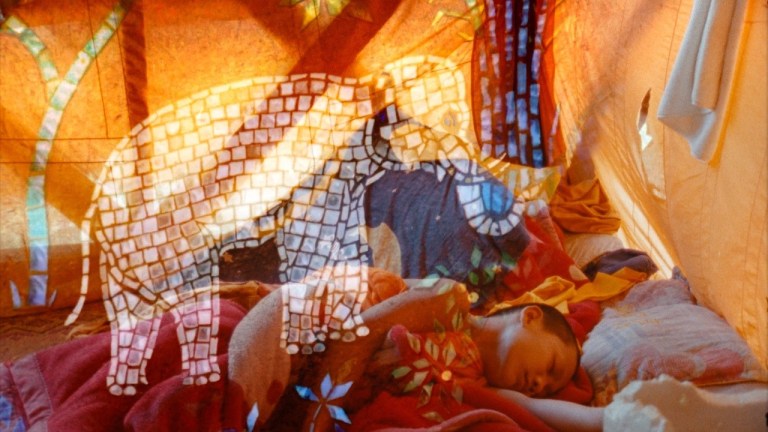
LP: It was overexposed, or white film, and I used that part and digitally colored it. I didn’t want to make very beautiful images, because I didn’t want the audience to open their eyes, but I couldn’t resist to make it a little bit beautiful [laughs]. So, what I did was I put one film behind another which was a little bigger, so that we can see the borders, and sometimes the border is in one color and the central part is a different color. I did multiple combinations of the external and internal one, so we could start to change it, and over it I put a black frame. In terms of opacity, I sometimes made it go down and disappear and other times up to reappear. So, we have the color in the background and the blackness appearing to make it completely black or disappearing gradually or by flicker.
NP: This makes me think of one of your short films, Strata of the Image, where you open the film with a quote by D’Annunzio that says something like “Colors are matter’s effort to become light;” was this something that was on your mind for the bardo sequence as well?
LP: I didn’t think about it, but it’s exactly that yes! It’s exactly that. It is a quote that I have in my body, it’s inside me, and in general, most of my works are about that. How to disintegrate the matter to dissolve in the wholeness; this idea of what Sigmund Freud called the “oceanic feeling,” and if you see most of my films, they finish in a dissolving of the matter or the human being in the landscape. Here in Samsara or my previous short film, The Sower of the Stars what happens is that the image itself dissolves into light or color. The end of The Sower of the Stars is like stardust; and here, it’s the same in this middle section. We disappear. For me, that’s a very high achievement. All my career I’ve been trying to find something to try to work with the sensual elements of cinema, the sense of matter [for instance]; here it is light and sound. The artist I admire the most is Rothko, and how he works with colors as matter and the vibration of those colors. For me James Turrell is like Rothko, but playing with the light of color, not the matter of color. And here I try to do the same in the film.
NP: I think you can feel that in most of your work, even in shorts like Night Without Distance and Mountain in Shadow…
LP: Yes, and in Strata of the Image it is the same with the waterfall, in the end the guy disappears in the waterfall. Also, in the Bardo Tödröl they say “recognize every light as your own light, recognize every sound as your own sound. Recognize the intermediate reality as your own,” and this is the oceanic feeling. This idea of feeling that you are part of the wholeness is one of the conceptual and spiritual points where I work from.
NP: It is a film that is in a sense made for the big screen, with the lights and sounds. I’ve seen it at home as well, and think it works really well even on a smaller screen if you have a dark room, but I was wondering how you have thought about this notion of one person seeing it alone at home, two eyes closed, versus seeing it with maybe dozens or hundreds of people, everybody closing their eyes together. This communal aspect.
LP: I think it gets more and more powerful the more people are in the room. If you are 50, it’s a strong experience, but if you are 500 it is even stronger. I think all this inner experience, the energy and the images that can be floating there, every body is a source of energy somehow. And being in a theater, knowing more people are there with their eyes closed next to you, people you don’t know or your friends, you can imagine what they are feeling and imagining [at the same time]. Also, the contradiction of being at such an inner experience, where you are inside your own body, not even having the connection between your eyes and the exterior; only your ears are open. Yet, it’s something collective. It’s very introspective, but collective at the same time. I was very happy with the idea because I knew that it would change the usual way of how it works at the cinema. Suddenly it becomes a collective meditative experience. I thought it would be a very radical experience.
NP: Do you know if it will have a physical home release on Blu-ray or something?
LP: I’ve never done it with my films. I want to. I want to make a box where everything is there, all the short films and the three feature films, but for now I haven’t spoken with anyone about it.
NP: To go further into this meditative collective experience, I know some people have talked about Apichatpong Weerasethakul in relation to the part in Laos, but there’s also this other notion that when I saw it in the cinema for the third time, a friend of mine fell asleep. I know Apichatpong welcomes it when people fall asleep in his films, but how do you feel about that?
LP: Well, I as a spectator always fall asleep. It is the perfect place to fall asleep. You are in a very comfortable dark room, so everything invites you to fall asleep. And if the film itself asks you to close your eyes, it is even harder to be awake [laughs]. And as Apichatpong, I like to always have this very slow movement and meditative tone. As for sound design, usually when you change from one scene to the next, you change the atmosphere in order to break it up a little bit, but most of the time I like to do it fluidly. Like, fade in the two atmospheres, to go softly from one to another, so everything is like a lullaby.
With Apichatpong I knew that he would appear in the film, so even if we were fighting to try to not be too similar, I have a similar style in terms of speed, [or] slowness. Also, thematically with reincarnation of course. Also, the oneiric experience, the limbo experience, the spectral experience. As we were shooting in Laos, the landscape, the architecture, the faces, the sounds, were all so similar that I knew it was going to be impossible to go away from his reference. If the film was only the first part, I probably wouldn’t do it, because it would be too similar. But since we have the other two parts, we can assume that it will appear, but later on we will break it. We also have what we think is an original idea in the middle section, and we aim to be more tactile in the cinema language in the Zanzibar part, so in the end it will become something different from him.
In terms of sleep, of course I prefer it if they don’t fall asleep, because they might miss something beautiful, but they can always come back, so it’s not a problem. Also, in terms of narrative, it’s not a problem to miss this or that, it’s just that you will miss some details that could be revealing for you. I try to bring as much poetry and beauty in the film [as possible], so maybe you miss a sound or some dialogue that could potentially be revealing for you.
NP: To switch gears a bit, how did you do research for the two parts around the bardo sequence?
LP: I got to Laos looking for a Buddhist place, and I didn’t know much about Laos [beforehand]. I wanted to go to places that you don’t see so often in the cinema. The film wants to be a celebration of cultural diversity, and a fight against the monopoly that the western culture has with the screens. This globalization and how the western culture makes differences disappear, and the cinema, the screens, the TV series, are the biggest tools they use to colonize the different cultures. So, I tried to bring these different cultures in order to show the richness of this diversity. With Laos, since I didn’t know much and we don’t see it often, that’s why I chose it instead of Tibet or Thailand. From a distance I saw that Luang Prabang, the city where we shot, was the cultural and spiritual capital of Laos, as well as one of the biggest points of Southeast Asia. And it was also really beautiful, next to the Mekong River, with these amazing waterfalls.
For Zanzibar I was looking for the biggest contrast possible, in every way. In terms of religion, landscape, culture. Also, as we were in a male community in Laos, since women are not allowed in the temples, I wanted to focus more on a community of women in Zanzibar. I was invited to do a video-art workshop in Zanzibar by chance when I was searching for this other place, and I thought it was great, it had everything I was looking for. I discovered this community of women who were working in these sea weed farms that were really beautiful visually, and sociologically it has been a way for the women [in the area] to have some income since the 1960s.
NP: How did you find the people you wanted to focus on and was there a collaborative process in the creation of the stories?
LP: After the first trips to each place, I wrote a script, but that was very minimalist and very open. So, when we did the second trip, during this pre-production process is where we were finding the places, getting to know the people, and talking with them. We understood everything better, and we learned a lot about what each location brings to the screen, and of course the biography of the characters we were choosing for each character. When we were in the process pre-production, I was doing my secret casting. Thinking this guy might play well with this character etc. For example, the kid in Laos who is not one of the monks, in the script he was not a rapper, but he was [in real life] so that was something we wrote into the script. He makes American style rap music, which talks about the globalization process, and that was something we were being very aware about; our position as European filmmakers traveling to these places. We didn’t want to be exotic or to romanticize, like an anthropology that wants to go to a burgeoning place. We wanted to show the mobile phones if they use them, and this rap music and all that. When we were talking with the teenage monks, they were adding me on Facebook and I was looking through their pictures and saw the selfies of them at the temples, and that inspired us to include the scene where they’re looking through these pictures in the film.
With the character of the father that runs the fish market in Zanzibar, I saw him working and he was a really funny guy. I thought it could be interesting to not just portray him in a documentary lens, but if we do a scene with him earlier, when we record him in this documentary style at the fish market, he will appear as a fiction character. We were doing things like that all the time.
NP: It seems very similar to Teddy Williams’ approach, who prefers to not do much research before he arrives somewhere and meet the people there to learn from them. But how did you pick the places like the waterfall, was the chosen beforehand or did you discover it through the people there?
LP: I went to the waterfall during the first trip, it is a touristic place. When I was doing research from afar, I saw pictures of the monks at the waterfall. That was a very strong image that I was looking for. We were lucky that they allowed us to record there with the monks, because some of the places people can’t go, but they allowed us to record for a few minutes.
We were working with local production companies in each country, which was really helpful. We only had four people who traveled from Spain. I worked with two different directors of photography for the two places, as it is speaking about reincarnation, I wanted the way of looking to reality to be different. It was the DoP, the sound designer, one person from production, and me. That’s of course because it’s a low budget film, but also because we didn’t want to be very invasive. We wanted the reality to be able to flow, and to work with local people in order to try to take out as much exoticism as possible. They were looking for locations before we arrived, and it was really helpful. For example, in Laos I didn’t know that such a huge school temple with 300 students existed. What I saw in my research work trip was temples with ten or twelve monks, and my idea was that. So, when they told me that we had the opportunity to shoot there, it was a big surprise.
NP: You mentioned the two cinematographers, and I find it really interesting that you can clearly see their different methods and sensibilities, for instance in Zanzibar Jessica Sarah Rinland has all these close-ups of hands in work, a very tactile feeling. Can you speak a bit more about that process?
LP: Yes, they are both cinematographers, but they are also both film directors. I know their work well, and I know their impulses. You can always ask a cinematographer to record like this or like that, but they have an impulse, and I wanted to go with that. Mauro Herce is more similar to my way of feeling, and this is the first time I’m not doing the cinematography myself. Herce is more about landscape and the atmospheric, and he likes to try to bring a spirituality from the image, with slow movements. In Zanzibar, as we were coming from this very ethereal, intangible, and spectral part in the middle section, I wanted to touch reality again. This is why I called Jessica Sarah Rinland. In her films, what you see is hands, most of the time: they are touching things and working. I wanted the objects to have matter again—the hands, the textures—as we are rediscovering life from the innocent perspective of the goat and the girl.
NP: It is funny, because the first time I saw the film I actually commented to a friend that the second part seemed like it was shot by Jessica Sarah Rinland, so it was a nice surprise to see her name in the credits. But the fact that the Laos sequence is shot by Herce makes me wonder if you’ve seen Eureka by Lisandro Alonso?
LP: Not yet, but I know that in terms of structure it is similar. I’m a fan of Alonso, but yeah, it hasn’t come to any theaters here, so I couldn’t see it yet.
NP: I wanted to ask how you think about temporality or time and space in your films, because in a lot of your early films the people are shot from a distance in landscape, but the sound is very close, which creates this strange rhythm.
LP: Yeah, I think as I told you before I try to explore cinema language from more sensual elements. And what you say about space and time, is what I tried in general in Coast of Death, my first feature film. What I try is to bring a different experience to the viewer of space and time. In Coast of Death, what I propose is that double distance between what you see and what you hear across distances, very close and very far away. I try to mix a very intimate experience, in the immensity of the landscape. So, these contradictory elements, and what it brings if you make the whole film like that. We’ve seen this in different films for some sequences, I remember a Kiarostami film with the car in the beginning, I forget which film it is, but they are in a car crossing the mountain and we hear the conversation inside of the car very close. What happens if we do that in the whole film? For me, it was also to try to put together human beings and landscape. This idea of feeling that we are part of the wholeness, and trying to bring our attention more to the landscape, not only to the action and the human being; try to break this anthropological centrality. It was more about exploring space and immensity, but with a contemplative interior and intimate experience.
In my second feature film, Red Moon Tide, I was exploring more deeply this experience of time. I was exploring it from people paralyzed in the landscape and how this will suspend time. This accumulation of immobility, the suspension of time, what will happen? We have the people paralyzed, as if they were trees, and we see the leaves of the trees and the waves of the ocean moving more than the characters. Our attention will focus more on landscape than the people, and at the same time here we hear the voices, but they are voice-overs, or thoughts, so it is a different experience of time and space as well. And hearing in Samsara is this radical experience in this middle section, and of course the experience of time changes completely as we don’t have any image where you can focus, so you will lose yourself in the experience of time, and you can go back and forth from reality to your inner experience.
NP: I think this slippage of time also comes up in the narrative of Samsara as well, with the monk that falls asleep and they joke that they’ve been looking for him for two weeks.
LP: Yes, I’m very interested in Henri Bergson and I think he’s the first one that distinguished between external time and internal time. External time is the time that flows into the space, touching the matter, and inner time is pure temporality. The external time is measurable by quantity or chronology, but inner time you measure by the quality of the experience. For me, as I work from the experience of the sublime, what I try to do in my works is that at one point people can connect really deeply with one image or one moment that opens what Gaston Bachelard called “vertical time.” It’s a synonym of the experience of the sublime. It’s a moment where the horizontal temporality breaks because you feel a strong connection with what you are experiencing, and that is important for me.
NP: Do you have a personal relationship to Buddhism?
LP: For me, it’s more of a cultural interest. As I told you, I’m more in the line of Mircea Eliade [and] how different cultures reflect around different things. In my previous short film, The Sower of the Stars, I explore Zen Buddhism more. I recorded already a new short film in Japan in a cemetery, also exploring Zen Buddhism: the art that appears from it, from paintings and haikus. Here, it is more in dialogue with how my culture in Galicia think about the afterlife, and how the Buddhists imagine it. And I thought it was such an amazing, creative, and imaginative book that it was really interesting. I think the film itself, the way the mother talks to the girl in the last scene [about how] there are different beliefs around all this is more my perspective. Each person in the audience will have a different belief. My perspective is more that when we die, we will die. But I’m very interested in all religions because I think it’s a very deep need that we have, or used to have. We can be very nervous about what can happen after, and we have the desire that something must happen, because we don’t want to believe that it’s the end, so religions appear to try to bring a response to that. I think it has been and still is very helpful to the people who need it.
NP: Finally, can you speak a bit about your new film Ariel?
LP: It’s a project that I was developing with the Argentinian filmmaker, Matías Piñeiro. We first did the short film, Sycorax, in order to see how we work together. It went very well, and was selected for the Quinzaine des cinéastes in Cannes, but then we had the problem of the pandemic and the calendar. We got some grants that meant we had to record it in April, and that didn’t work with Matías’ calendar, so now I had to direct it myself. So, I adapted the script that we had to something more connected to my interests and capacities, but I keep the theme and most of the ideas [we made together] of course. Ariel is a free adaptation of The Tempest by Shakespeare, and it works a lot with Luigi Pirandello’s Six Characters in Search of an Author. It is recorded in the Azores islands, the Portuguese islands in the Atlantic Ocean, and these islands become the islands of the characters of Shakespeare: where all the plays are taking place. It is the local people of the Azores that are playing Hamlet in the supermarket, or Othello in the gas station, things like that, but with existential doubts on their reality as characters. I think it has something connection it with my work, but it’s an idea that belongs with Matías Piñeiro so it’s also different from what I’m used to.
NP: I wanted to finish off by asking you if you’ve seen anything good in the cinema lately?
LP: I think the last one was the new film by Radu Jude, Do Not Expect Too Much from the End of the World. It is a really unbelievable film. You remember this sentence by Pasolini, where he says something like, “what the spectator like more, is the freedom of the author.” And here with Radu Jude, you see someone who is completely free with the will to provoke a reflection about the society and how this contemporary society is developing with a very acid humor, but at the same time it’s very deep. He’s doing whatever he wants, and bringing new narratives, new structures, new ways of showing reality. He’s a really strong filmmaker.

