To place any one filmmaker’s work within a single tradition is a treacherous task, more often reductive than instructive. Yet, sometimes, it can illuminate certain aspects of their practice: as in the case of Ana Vaz, who quite clearly works within the post-colonial, anti-capitalist tradition, thematically as much as aesthetically.
Ana Vaz engages explicitly with the work of thinkers such as Paulo Freire and Frantz Fanon in her texts, and her images and flow disrupt and distrust the Western aesthetic. Her films profusely refuse and repel the Western image, and her refusal takes both ideological and material shapes as in the inimitable Apiyemiyekî! in which superimpositions of historical material change the context of her own recordings. Her experimental form never obfuscates her ideas, however—a tired and trite notion about experimental filmmakers, in general—as she roots her ideas in concrete historical moments or contemporary political struggles, rather than approaching them from a purely abstract theoretical or conceptual front.
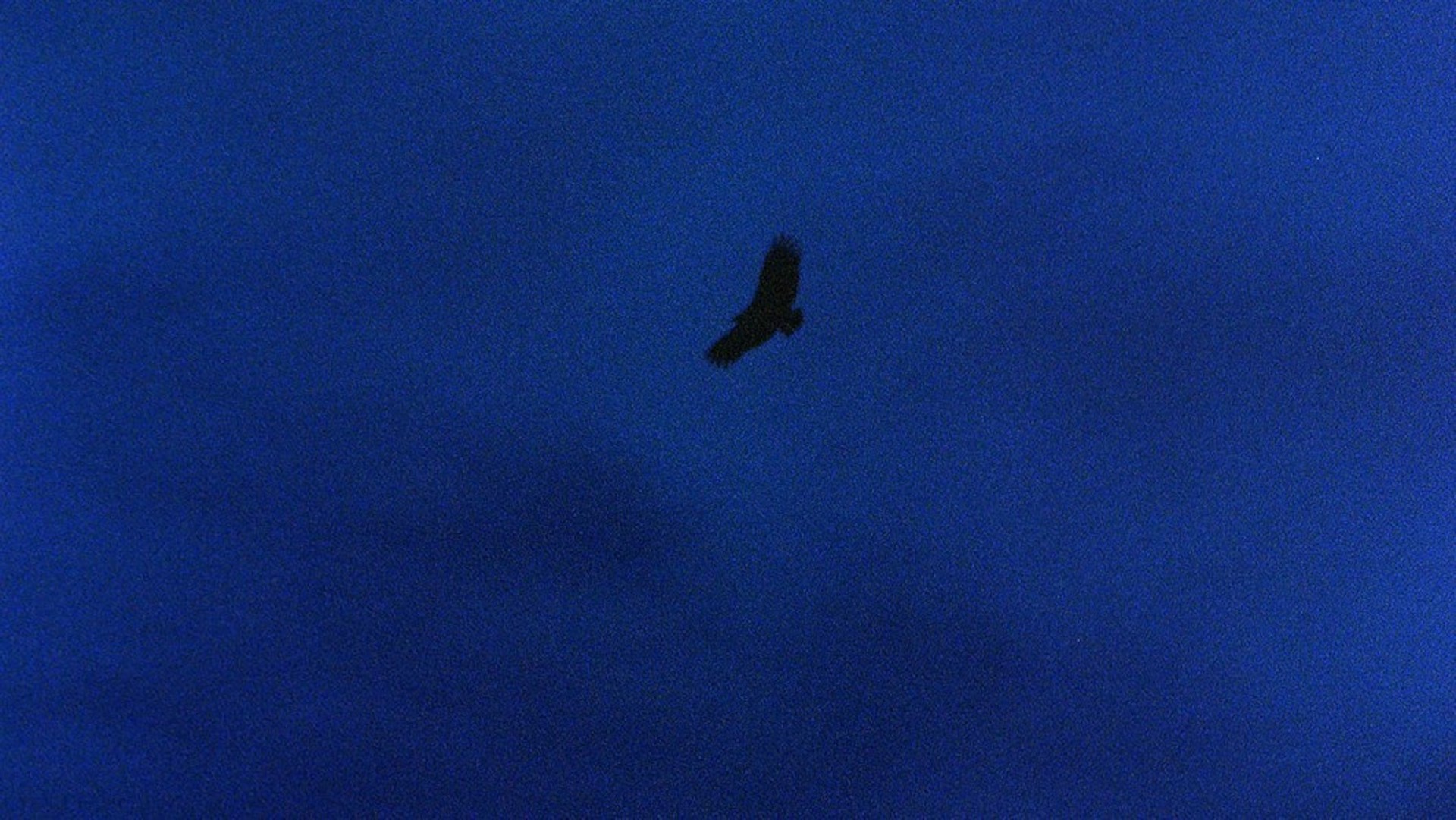
It Is Night In America sets its sights on Brasília, the concrete capital of her native Brazil, and the devastation caused by the rapid expansion of late-stage capitalism on the local fauna of the region. Once it was decided, in the 1950s, that Brazil was to build a new capital city in place of Rio de Janeiro, the construction saw the displacement of an enormous proportion of local fauna, and to this day, they linger and haunt the city and its concrete streets.
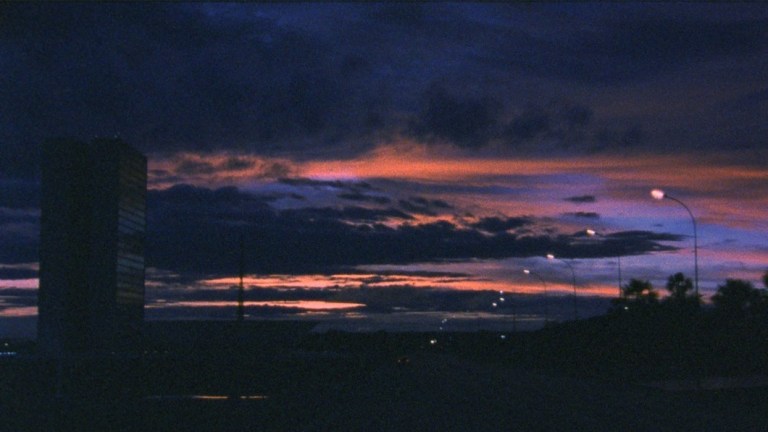
As Vaz’s first feature film, at a lean 66 minutes, it’s impressive to see how much of Vaz’s sensibilities seamlessly work to create a longer “narrative.” Vaz’s camera becomes almost a nocturnal observer, the expired 16mm film stock drenched in the black, purples, and blues of early mornings in Brasília; before the bright sun drenches the city in light.
The film opens with a wide shot of Brasília, placed firmly atop the roof of a high rise, the camera spins to properly consume the landscape of metal, stone, and glass that seem to stretch to the horizon. The camera gyrates faster and faster until the screen is subsumed by blues, purples, and blacks, in unintelligible lines of chaos. In his less than enthusiastic review for In Review Online, Zachary Goldkind, suggests it’s a nod to the final moments of Chantal Akerman’s The Eighties. An evocative parallel (and one that makes a lot of sense), but one can also make the case for Akerman’s excellent La Chambre; the camera ripped away from the comfortable intimacy of Akerman’s apartment bedroom and thrust into the dark blue hues of a cold and careless early morning in Brasília.
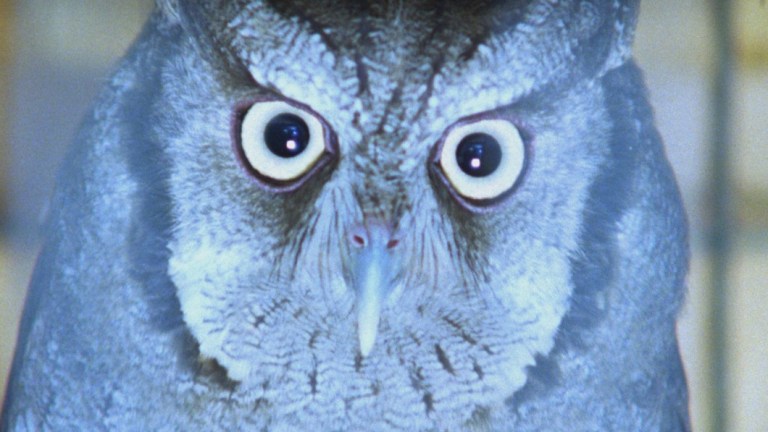
In the immediate aftermath of this sensory opening sequence, Vaz slows down and takes us closer to the ground. Her camera observes various animals in various circumstances and surroundings; from capybaras enclosed in small stone cages, to what looks like a fox hurriedly crossing the road, and an owl, pensively watching the world move too fast even at night. Accompanied by different voice-overs, taken from calls to forest officers about wildlife, or conversations with veterinarians who fight an endless fight on behalf of displaced animals. Interspersed in all the sequences of animals, are scenes of modernization and metropolization in full effect. Construction of new buildings or roads is presented without further context, but they still weigh heavy on the film. There’s an element of intertextuality to this, Vaz in a sense reflecting on her own work—deliberately or not—as these roads weigh equally heavy in films such as A Film, Reclaimed, and Apiyemiyekî!, the latter of which, about the genocide of the Waimiri-Atroari people in the 1970s so a highway could be built, haunts this film throughout.
These scenes, with their mediative gaze, have received criticism from some for being shallow poeticism, which is to miss the point entirely. Vaz’s refusal of traditional narrative modes is not about obfuscating an issue in a cloud of mysticism, but rather using the formal language of cinema to fully explore said issue. It’s not about a lack of praxis in the face of an insurmountable obstacle—neoliberalism’s dehumanization of all living things, a trait it has inherited directly from settler colonialism—but an effort to make that obstacle felt in the film itself. Film is, after all, a sensory medium, and Vaz engages our senses to the fullest. Her use of expired 16mm film stock is about materiality and, as she’s said herself in an interview with Variety, “we’re dealing with … the extinction of the image itself, and the extinction of these beings.”
It Is Night In America is shot almost exclusively at night, or at least made to look like it through a day-by-night process, and there’s a tangible sense of elegiac beauty throughout. Yet, as the brutal devastation of the tactility of animal life in a world fuelled by a constant flow of money sets in, Vaz doesn’t succumb to despair. She seems to see a light, or a possibility for light to shine again by the end of the film, and while all expired film stock will eventually degrade further, Vaz seems to suggest there’s a future for humans and animals to cohabit once again, if only we make some sacrifices. Unlikely, but small steps.

