I have a very fond recollection of the years 2011 and 2012, in terms of movie experiences. These were some of the first years where I truly started to explore cinema, although I had been passionate about it for many years before. I went to the Bergen International Film Festival by myself for the first time in 2011, where I saw films like Martha Marcy May Marlene, Meek’s Cutoff, Drive and Sleeping Beauty. In 2012 I signed up for the streaming service MUBI (which I am still subscribed to now, 8 years later). The reason I signed up was two fold: to further explore international cinema, but the main reason was to watch a small, obscure new Norwegian film that was distributed by the streaming service domestically. The film in question was Maybe Tomorrow (Kanskje i morgen) by Mariken Halle, a graduation film from the film school in Gothenburg.
Maybe Tomorrow and Mariken Halle’s cult status was immediate when it was first released through MUBI. The small selection of people who saw it in its first run, all seemed to have a lot to say about it—praise or otherwise. It was one of those rare instances where there seems to occur a shift in the perception and national conversation around film. The influential film publication Montages wrote: “Maybe Tomorrow is fascinating, frustrating and annoying. At the same time it carries with it a message that might signal a paradigm shift for Norwegian film that we haven’t seen the likes of since Pål Jackman’s Detektor in 2000.”

There seemed to be a consensus, even among those who did not particularly like Maybe Tomorrow, that Halle was a much needed voice for Norwegian cinema. Her second film, The World is Waiting (Verden Venter), was also quite divisive, but this time even more people talked about the importance of her work. I first saw it at a special one-time screening at Bergen in 2014, followed by a conversation with Halle, and I was struck by how everyone in the audience stuck around for the entire talk. Outside the venue, people congregated to discuss it. Strangers in deep arguments about a film. Not necessarily whether they liked it or understood it, but rather, what it meant for our national cinema. Then Halle disappeared from the public for many years. It was only in November 2019, that she announced that her new film, We Are Here Now, would premiere at the Tromsø International Film Festival in January 2020, six year’s later. The film had a limited theatrical premiere on February 28th, before the COVID-19 pandemic closed down every theater in the country two weeks later. I had a chance to watch it twice before this, and it is absolutely as important and smart as her previous features, and desperately in need of the same conversations those were afforded by the national press.
Halle’s movies exist somewhere on the peripheries of genre and tone. Countless filmmakers blur the line between fiction and fact, or the staged and the documented, but few do it with the same tact and intelligence as Halle. Her approach, from the few pieces of behind-the-scenes information that has been made available (mainly through The World is Waiting), seems to be one that puts the performer first. Her films are populated (mostly) by amateur actors (with a few exceptions like Bianca Kronlöf), who, at least in The World is Waiting, work without a screenplay. They are given a short description of who they are as characters, what their life is like and sometimes what they’ve been doing earlier in the day of the scene they populate.
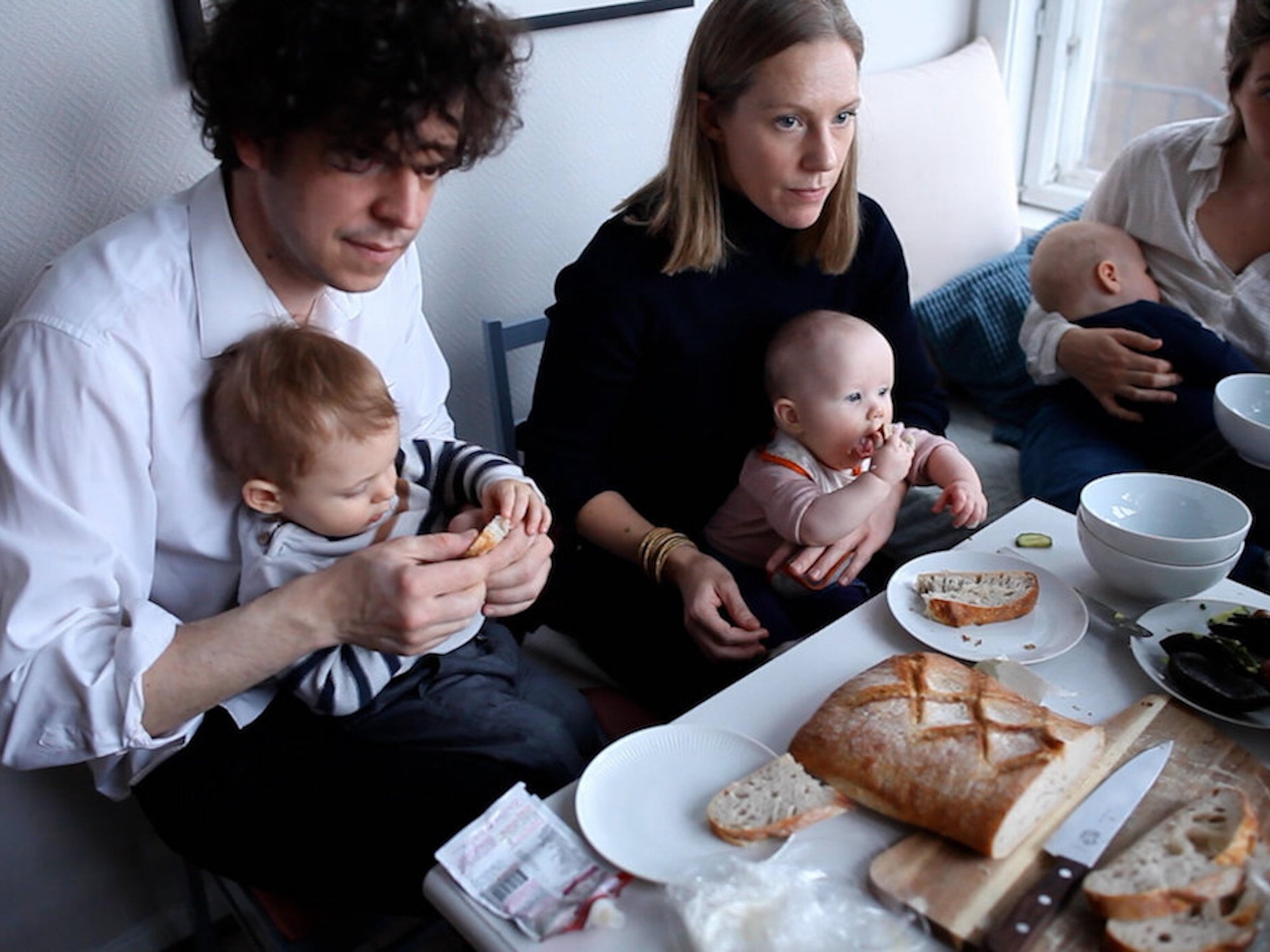
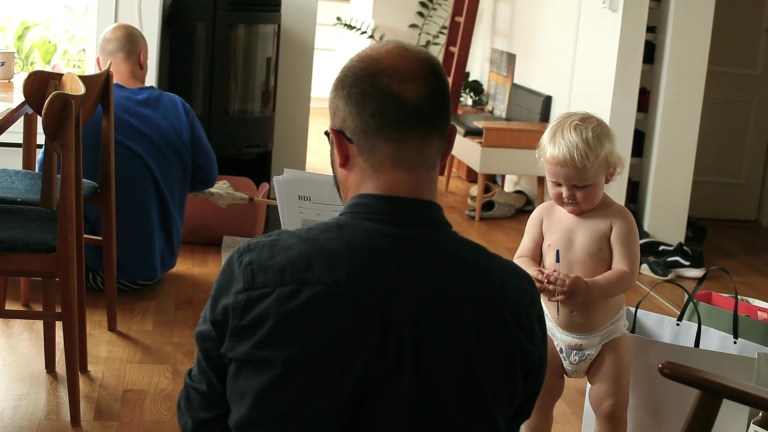
We Are Here Now follows a group of babies and their parents for a year, as they meet regularly in their paternal leave to socialize with people who share in their experiences of being a new parent. We, or Halle’s camera, become an observer as they meet, listening in on their conversations, arguments, confrontations and frustrations. Different parents (and babies for that matter) are afforded moments of focus, but I don’t want to talk too much about the different scenarios that unfold, because that would be to take away from the experience of the film. It’s not a film you can “spoil” in the traditional sense of the word, because there is no traditional plot or narrative thrust here. We observe these people in their lives, from a few bigger moments to the mundanities of everyday life. This is where We Are Here Now excels, in the way Halle captures the mundane.
Films tend to aestheticize real life scenarios in various ways, whether it be through heightened drama or subtlety. A lot of brilliant directors manage to make quiet moments feel authentic to real life through subtlety (look at Andrew Haigh or Kelly Reichardt), but Halle seems to actually capture real life, not manufacture it. This is, of course, not to say that one is better than the other, only to point out the differences. Halle allows real life (in this case the natural and essential improvisers of the babies) to become the scene. For instance, when one couple talks about mental health, they are not afforded the grace and quiet that usually follow scenarios like this in film, as they are interrupted and distracted by their child. It is almost like Halle is actively forcing the mundanities of everyday life upon us, and turning the idea of cinema as distraction or cinema as catharsis in on itself. Whereas Maybe Tomorrow and The World is Waiting are engaging more directly with the question of “what is film?” Halle’s third feature seems to be more interested in a different sets of questions about what film is not. Why cannot cinema be mundane? Why can’t cinema be real, even when it’s not? Can the mundane form a catharsis? How can you be present in cinema and real life at the same time?
It is this final question that is the most pressing in regards to We Are Here Now. It is certainly a challenging film, and I can completely understand how certain critics and audience members struggle to be engaged throughout. Yet, I can’t help but appreciate this uncompromising embrace of the mundane, or even boredom.
Directors intent is a popular buzzword in conversations surrounding film. What is the director’s intent? Does the director’s intent matter? I tend to subscribe to the idea that intent comes second to the experience of the viewer, but that feels particularly true for Halle’s oeuvre. Halle is credited as director, writer, cinematographer and editor on her latest film, and it might seem like these roles blur together. I say this not to sideline her work or reduce her accomplishments, but to highlight the fact that she is an artist in the truest sense of the word, and that traditional titles almost do her vision a disservice. Her voice is idiosyncratic and visionary, and the fact that she manages to retain this throughout her work, even when that work is dictated by her performers to different degrees, is a testament to the strength of her overall vision.
Mariken Halle’s films have been criticized for being too slow or even boring, and by some for “not being films” at all (whatever that means). I can understand how certain audience members would struggle their way through one of her films, but I am convinced that she is one of the most fascinating directors working in Scandinavia today. There seems to be an irony in how her films mimics real life when you watch them, but inspire deep dialogues when you finish them. Her films require you to be present; in the film, in your life outside the theater and in the ideas and thoughts that come to you when these two “real worlds” collide in the illumination of the screen. While her films may be challenging to watch, and even challenging to like to some extent, they are impossible to ignore or forget. They inspire a deep reflection on the amalgamation of film and life, one that keeps you present in both worlds as you watch them, as well as in the days that follow.

